
Power at scale,
without the footprint.
Rack-scale solid-state power conversion for any system where megawatts must stay compact.
The new constraint isn’t capacity.
It’s infrastructure.
Hyperscale Power® approach
Traditional power architectures scale with infrastructure: larger rooms, heavier installations, and increasing system complexity.
Hyperscale Power enables high-density conversion at medium voltage, allowing power to scale while infrastructure remains compact and modular.
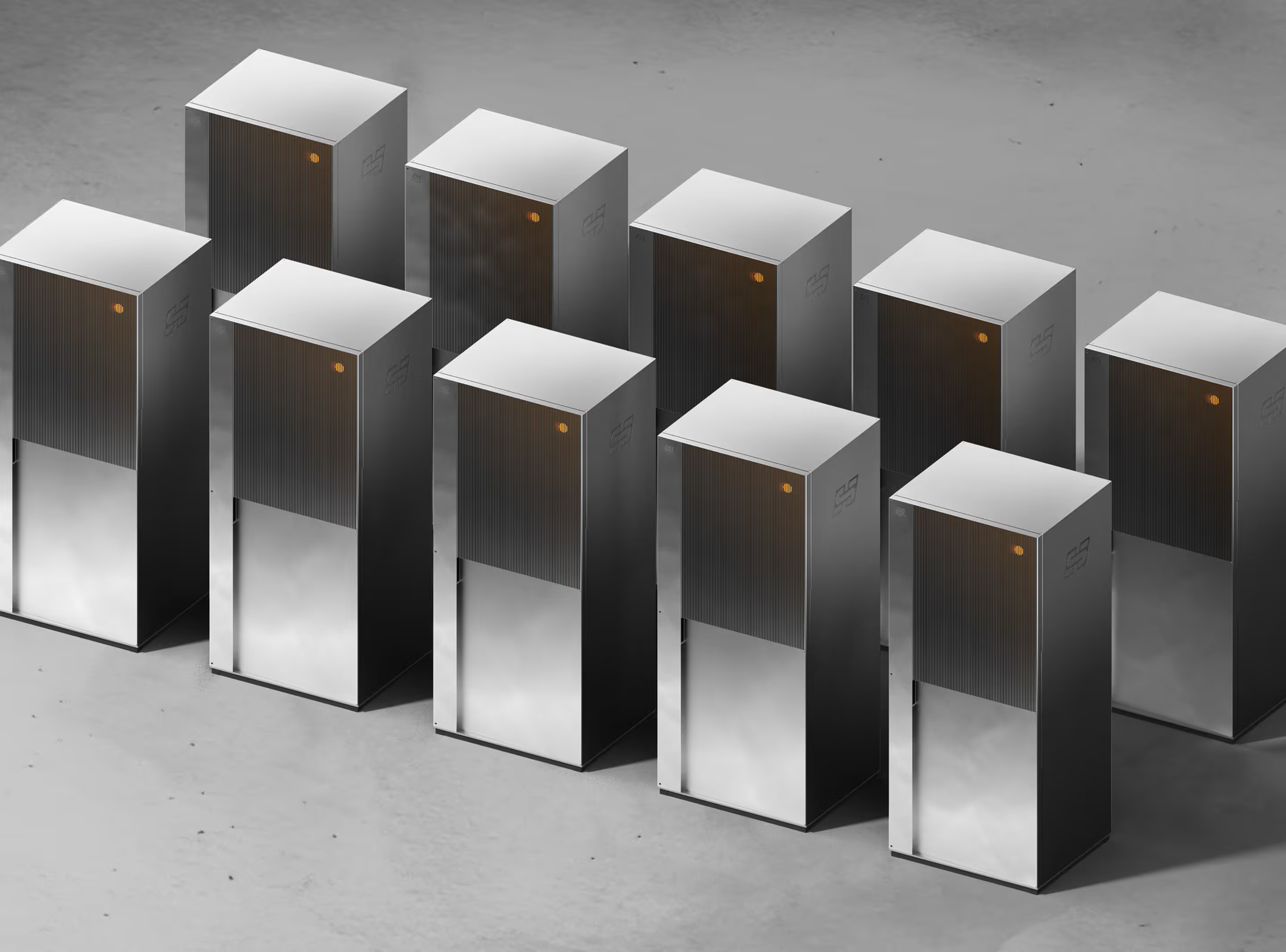
Power density
has changed the rules.
Power demand is rising across infrastructure systems.
As power scales, footprint and conversion efficiency become critical design constraints.
Medium-voltage conversion enables power to scale without expanding infrastructure.
One platform.
Multiple high-density systems.
Hyperscale Power is built for environments where power, space, and efficiency are tightly coupled.
Designed to integrate.
Built to scale.
Want to know more?
Start a technical discussion with our staff and receive documentation related to your company.
Our ecosystem



Explore our latest
achievements and news.
Wondering
about something?
What is a Solid-State Transformer?
A Solid-State Transformer (SST) replaces conventional 50/60Hz transformers using advanced power electronics and wide-bandgap semiconductors like Silicon Carbide (SiC) and Gallium Nitride (GaN). The result is a transformer that is significantly more compact, more efficient, and offers precise, real-time control over power flow, capabilities that legacy transformers simply cannot match.
Hyperscale Power's SSTs bridge the gap between the medium-voltage AC grid and the 800V DC buses that next-generation AI data centers require. They also natively support direct integration of battery storage and renewable energy sources, making them a foundational building block for the data centers of the future.
What problem do SSTs solve, and why are they superior to traditional transformers?
AI server racks are expected to demand up to 10x more power within the next two years, while occupying the same physical footprint. Conventional 50/60Hz transformers have reached their fundamental size and efficiency limits and cannot meet this demand. They are too bulky, too lossy, and offer no control over power flow.
SSTs solve all three problems at once. They are smaller, more efficient, and fully controllable, enabling AI data centers to scale their power delivery without expensive infrastructure overhauls or sacrificing valuable floor space.
Where do Hyperscale Power's SSTs fit into the current energy and tech landscape?
Data centers are undergoing a fundamental shift in power architecture, moving from AC to DC distribution to handle the explosive growth in compute demand. SSTs are a critical enabler of this transition, converting medium-voltage AC from the grid directly to the 800V DC that modern AI infrastructure requires.
Hyperscale Power is building the most compact and efficient SSTs on the market, leveraging the latest advances in power electronics. This gives data center operators a clear path to scaling without being constrained by legacy power delivery equipment.
Why are solid-state transformers relevant right now?
The timing is not coincidental. AI server rack power densities are approaching 1 megawatt, a threshold that makes today's transformer technology commercially and physically unviable. The data center industry knows SSTs are coming, the open question is which technology will be ready first, and which company will set the standard.
Hyperscale Power is building for that window. The companies that establish SST supply chains and integrations in the next two to three years will define the architecture of the next decade of AI infrastructure.
Who is behind the technology?
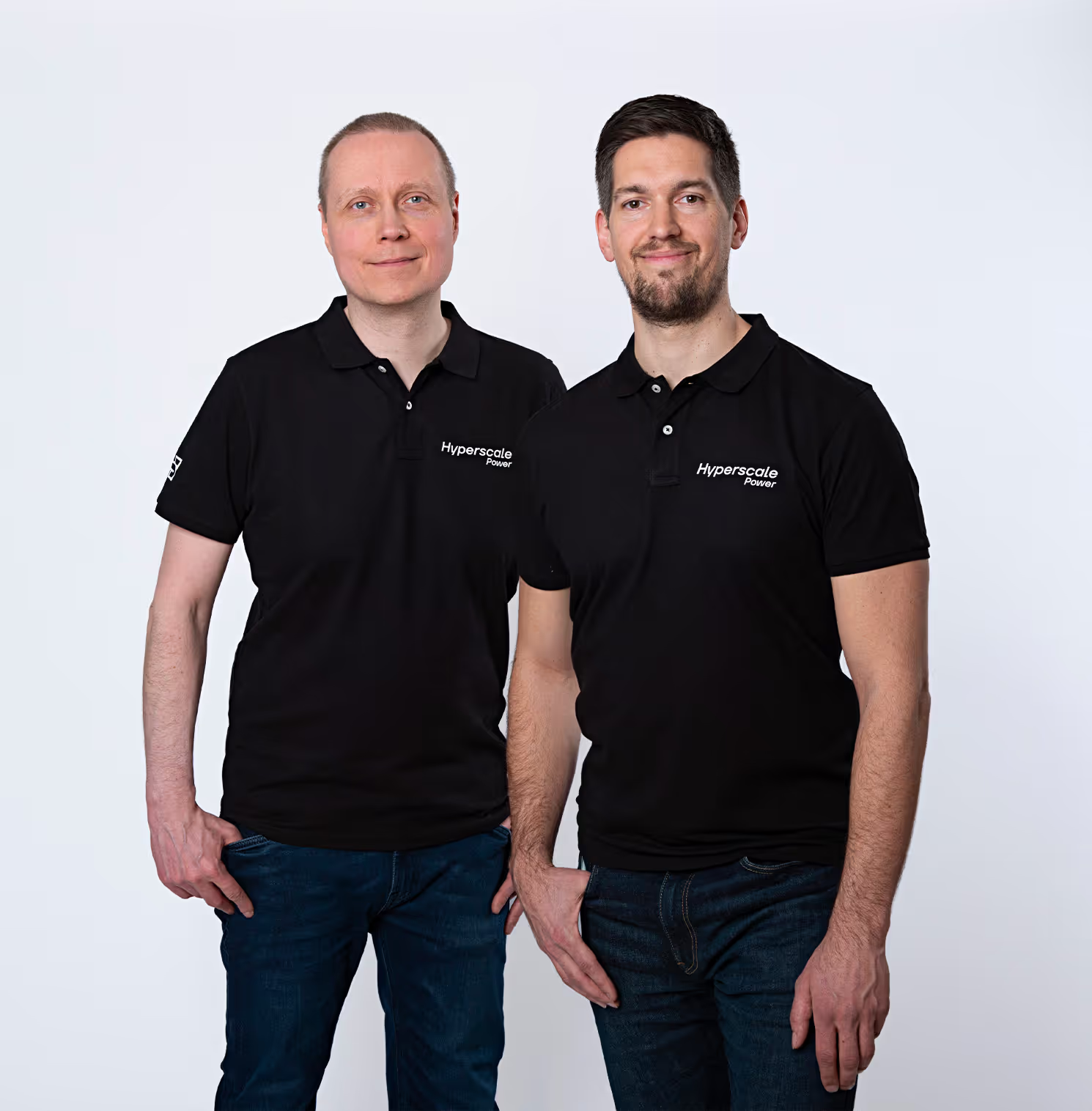
Hyperscale Power was founded by Dr. Daniel Rothmund and Dr. Sami Pettersson, both power electronics experts with extensive industrial experience in SSTs, medium-voltage systems, and grid-connected power conversion. They identified that their research, previously confined to academic and industrial labs, was precisely what the market urgently needed.
The broader team combines deep engineering expertise across power electronics, magnetics, thermal management, and embedded systems, giving Hyperscale Power the multidisciplinary foundation required to bring a genuinely complex technology to market.
How is Hyperscale Power different from a typical tech startup?
Most tech startups are built on software or incremental hardware improvements. Hyperscale Power is building critical energy infrastructure from the ground up, a category that demands years of domain expertise, not just fast iteration.
Our founding team was researching SSTs before the commercial demand existed. We are the only European company dedicated exclusively to solid-state transformer development, and we combine genuine technical depth with a clear industrial roadmap. We are not adapting existing products, we are defining a new product category.
How can I get in contact with Hyperscale Power?
Reach out through our contact form. Whether you are a potential customer, partner, or investor, our team will get back to you promptly.
What industries beyond data centers can benefit from SSTs?
While AI data centers are the primary near-term market, SSTs have broad applicability wherever efficient, controllable power conversion between medium-voltage AC and DC is needed. This includes EV fast-charging infrastructure, industrial facilities, offshore wind and solar integration, maritime applications, and railway systems.
The underlying technology platform Hyperscale Power is building is relevant across the full energy transition.
How does an SST integrate with existing data center infrastructure?
Hyperscale Power's SSTs are designed to slot into the medium-voltage entry point of a data center, replacing the conventional transformer and rectifier stages with a single, compact unit that outputs 800V DC directly.
This simplifies the power chain, reduces conversion losses, and enables direct connection of on-site batteries and renewables, without requiring a full redesign of the facility.
What are the main technical barriers to SST adoption, and how is Hyperscale Power addressing them?
The core challenges in SST development are managing switching losses at high frequencies, thermal management at high power densities, and ensuring reliability over long operational lifetimes. Hyperscale Power's team has spent years working on exactly these problems in research environments.
Our approach combines SiC and GaN switching devices with advanced magnetics design and proprietary control architectures to meet the efficiency and reliability standards that industrial customers require.